Saturday, 4 August 2018

attempt on the pic d'anie / tentative sur le pic d'anie


Attempt on pic d’Anie (pour le version  francais vois en dessous les photos). 

The good bits: 
I slept under a canopy of stars the night before
I spent an enchanted hour or so o the GR10, walking through what can only be described as a gigantic natural rock garden.  Cast a quadrant and you would have caught a dozen flowering species, plus a few butterflies if it had a net.  It’s a mystery to me why nutrient poor limestone soils harbour such rich diversity. 
I saw some marmots, for the first time in my life.  They were much larger than I expected (beaver size) and completely unfazed by my presence.  I watched three of them graze and play for five minutes and even when I moved on they did did not gointo hiding
I took a photo of my father with me, who passed away five years ago – almost to the day.  I wanted to do something in memory, so decided to share one of the things that I enjoy with him (that we never shared in real life)   and have a last (?) conversation.

Bad things
I didn’t make it to the top – it was far too hot I should have set out at seven to have had a chance
Most of the approach to the foot of the mountain has been bulldozed to create a 5-7m wide ski piste.  It made the approach feel like walking the Kakokoram Highway. Totally ugly and dispiriting.  An act of ecological vandalism, desecrating a beautiful and to the Basques, holy, mountain. It was a large part of the reason I gave up on my attempt on the peak.     I can’t remember when I felt so viscerally angry.  Yes, I would have stood in front of the bulldozers had I known about the plans.  And I will encourage people in Hendaye I know who go ski-ing to boycott that resort in the future.
Back at ‘base camp’ I met someone having a beer (who it later turned out works at the resort) and told him how I felt about what had been done.
‘Ah but they had to, otherwise the skiers would go elsewhere’
Now, the hikers won’t come ‘
‘But the skiers spend far more’
As Mr Zimmerman said ‘Money doesn’t talk it swears'.


version francais

Essai sur la pic d'Anie

Les bons morceaux:
·         J'ai dormi sous une canopée d'étoiles la veille au soir
·         J'ai passé une heure enchantée au GR10, à travers ce qui ne peut être décrit que comme un gigantesque jardin de rocaille naturel. Jetez un quadrant et vous auriez attrapé une douzaine d’espèces en fleurs, plus quelques papillons s’il avait un filet. C'est un mystère pour moi que les sols calcaires pauvres en éléments nutritifs présentent une telle diversité.
·         J'ai vu des marmottes pour la première fois de ma vie. Ils étaient beaucoup plus gros que j’ai prevu (taille de castor) et complètement indifférents à ma présence. J'ai regardé trois d'entre eux paître et jouer pendant cinq minutes et même quand je suis passé, ils ne se sont pas cachés
·         J'ai porte une photo de mon père avec moi, qui est décédé il y a cinq ans - presque jour pour jour. Je voulais faire quelque chose en mémoire, alors j'ai décidé de partager l'une des choses que j'apprécie avec lui (que nous n'avons jamais partagé dans la vie réelle) et d'avoir une dernière ( ?) conversation.


Mauvaises choses
·         Je n'ai pas atteint le sommet - il faisait trop chaud, j'aurais dû partir à sept heures pour avoir une chance
·         La plus grande partie de l’approche au pied de la montagne a été détruite au bulldozer pour créer une piste de ski de 5 à 7 mètres de large. Cela a fait en sorte que l’approche donne envie de marcher sur l’autoroute Kakakoram. Totalement moche et décourageant. Un acte de vandalisme écologique, en profanant une belle montagne, sacrée des Basques. C'était une grande partie de la raison pour laquelle j'ai abandonné ma tentative sur le pic. Je ne peux pas me souvenir quand je me suis senti si visiblement en colère. Oui, j'aurais été devant les bulldozers si j'avais eu connaissance des plans. Et j'encourage les gens de Hendaye qui je sais, qui skier, à boycotter cette station à l'avenir.
 
De retour au «camp de base», j'ai rencontré quelqu'un qui buvait une bière (qui par suite j’ai appris est fonctionnaire sur place) et lui a dit ce que je pensais de ce qui avait été fait.
« Ah mais ils devaient le faire, sinon les skieurs iraient ailleurs » 
« Maintenant, les randonneurs ne viendront pas »
«  Mais les skieurs dépensent beaucoup plus »   
 

Comme l'a dit M. Zimmerman, «l'argent ne parle pas, il jure ».

Sunday, 11 March 2018

Baratzea - end of winter


The garden doesn't require daily care over the winter  and the first spring flowers are showing. 


And I have got quite a done between the seemingly endless days of rain. 

  • I have a new composter, courtesy of the Marie.  It took four visits, five phone call and seven e mails to locate which department actually would deal with my request, but I got it in the end.  The old one made of old pallets was not very pretty and didn’t work so well as it let in too much air.   The owner of the site was pleased to see the site look less ‘Heath Robinson'.
         

  •           I recuperated a van full of attractive Ribes cuttings around Christmas time which should prove useful as supports over the coming year. 


  •   I’ve laid in borders to delineate the beds from the pathways, using the planks from the palettes from the old composter.  Again  the land owner is pleased and the owner of the épicerié  that looks over the garden said how much nicer it looks.  I am thinking of laying down some ‘hard materials’  in the pathways , again to make it more attractive – oyster shells are my first choice – if I can find enough (When discussing this idea with a friend she did some research and told me that France throws away 40,000 tonnes of oyster shells a year, so there should be plenty enough for my garden). 

  
  •  I’ve planted up the fence around the garden with cuttings of forsythia, wisteria and hyacinth that I took from a guest house (with the owner’s permission) in January. Growing things around the perimeter was a priority last year but nothing took.  Hopefully these will, making the fence more colourful and attractive, visually enclosing the land, attracting insects, protecting the site against wind and increasing the ambient temperature. They're starting to take. And, the fig tree that I transplanted in November, that I thought hadn't survived the experience,  is showing signs of life.
  • I reinvested some of the profits from last year’s unexpected tomato sales in some bushes:  raspberry variants (Tayberry and Japanese wine berry) gooseberries (two varieties) and a vine to grow on the trellis.  I also took some raspberry shoots from a neighbour, though they’re not looking too healthy at the moment.   I met an Indian spice grower at Biofach who advised me to pinch out the flowers so all the energy goes into the plants’ development in the first year.  So I will take his advice and defer my gratification from those in the first year. 
  •  I have some magnificent chard and some weak looking leeks, brassicas  and black radish that might yield an early crop: partially keeping me in winter vegetables.  There were some potatoes (killed by the frost) now I understand why people 'trench' them.  
7.       
Many thanks to Claire and Joseba who supplied me with the raspberries (and did the research on oyster shell wastage) to Tony and Jane from Helette for the bush cuttings and to Will Hall, a couchsurfing guest who turned into a WWOFFER and did much of the work of sawing up the palettes from the old composter and laying down the borders. 

Spring is on the way! 

Tuesday, 20 February 2018

Down and out in Paris..

and Frankfurt and Nuremberg and Hendaye and most other places in the western world.

Last week I was in Paris and, looking for somewhere to eat, I found myself in Place de la Republique (not the best choice for eating out).  There was a large group of people, three hundred or so, gathered in the square, so I wandered  over to find out what was happening. It turned out it was a soup kitchen, catering to the homeless and destitute of Paris.


 One of the volunteers waved me over and offered  me a bowl of food.  (Do I look that rough?)  It was a tasteless mix of cous-cous and carrots. I could hardly eat it.  But at least it was warm, full of carbohydrates and vitamins.  I offered a donation and the volunteers refused, saying please contribute via the net .  George Orwell wrote about this in the 1920's.  Ninety years later, have things not got better?  It seems not.

A few days later in Nuremberg I made acquaintance with a young spice grower from India, attending Biofach, and on his first visit to Europe. He asked me lots of questions - including why there where so many beggars on the streets. I didn't have an answer.  It's not a specifically German, French or British problem.  I tried to explain some of the issues, knowing that  middle class Indians have in-built defence mechanisms against beggars, including the much repeated (and hopefully untrue) story that some children are mutilated at birth to make them more 'beg-worthy'.   He looked askance at me when I dropped a few coins into beggars'  plastic cups.

There are definitely more beggars and homeless people on the streets of the western world than there were twenty years ago. This is not a problem restricted to one country or its policies.  We can't blame May or Macron or Merkel.  one might try to avoid them, but if you spend any time at any major railway terminus it is just not possible (and I have spent a lot of time at  major railway termini this past week)

So how do we respond to this human suffering? To alleviate the immediate problem you can take out a standing order to support, or preferably become a volunteer with, an organisation such as restos du couer.  But in the longer term, we need political change, and if I knew how to achieve that I would be more content. 

Monday, 19 February 2018

Organic Trends 2018

Just back from Biofach with a few taste treats from generous exhibitors. 


My twelve hour train journey home allowed me to read through most of this year’s ‘World of Organic Agriculture’, the nineteenth edition of the most authoritative source of statistics and commentary on the state of organic farming.  Here’s ten highlights from this year’s edition (all percentile changes refer to 2015-6).
  • ·         15% increase in global organic certified land (though an estimated 2/3 of this is due to better data collection). (In ten years certified organic land has almost doubled).
  • ·         13% increase in number of organic producers worldwide (again, some of this is due to better data collection). (In ten years the number of organic producers has grown by 120%).
  •       Organic food now has more than a 5% share in seven countries, including among  the 'usual suspects, the Nordic and Alpine countries) the USA!
  • ·         8% growth in organic land in Europe and a 10% growth in the organic market.  In Ireland, France, Denmark and Norway the organic market grew by 20% or more 
  • ·         15 countries now have more than 10% of their land certified as organic, including Austria, Sweden, Italy, Switzerland , the Czech Republic, Finland and Uruguay       
  • ·         More than 25% of temperate fruits grown in Austria, Bulgaria, the Czech Republic and Montenegro are organic.
  • ·         More than 10% of the grapes grown in Italy, Austria, Bulgaria and Spain are organic
  • ·         More than 25% of French olives and almost 20% of those from Italy are organic.
  • ·         There’s almost one million ha of organically managed coffee in the world (8.5% of the world’s total)
  • ·         An estimated 33% of the world’s coffee, 25% of the world’s chocolate, 16% of its tea and 10% of its cotton are grown under various sustainability labels, including organic (NB figures are estimates that allow for possible ‘double-certification’).


All of which begs the question: is organic still a niche? 

Tuesday, 28 November 2017

Baratzea - November

I've just had a crash course in wild and semi-wild plants. I met a traveller this summer admiring my garden and we immediately hit it off and went on several foraging missions together. She's been back in Hendaye for a few days and every day we have been exploring my garden ad the open spaces of Hendaye with her teaching my the names and uses of the wild plants in my environment.  And then going home and spreading out five botanicae on the floor checking out the names and uses that my friend doesn't know.

These days there's not so much work to be done in the garden so it's been great to move forward with my (somewhat dormant) project of getting to know the names and uses of the plants around me.


Top to bottom then left to right
Banana leaf (ideal for a lampshade)
Sunflower head (30cm diameter)
Chard
unknown berries
Palm and wisteria seeds
Mache (Lamb's lettuce)
Primula


Rocket


Lamb's lettuce


Cresson de Fontanine

Saturday, 25 November 2017

In the gallery.

Last week I was in Bilbao and took the opportunity to visit the Guggenheim.  I was of the impression that the building greatly outshone the works inside until I found myself on the ground floor and confronted with the most impressive set of installations I have ever come across:


These eight steel mazes amazed me.  Some were spirals, others shell-like, others parallel sheets.  Richard Serra, the artist responsible, plays with concave and convex curves in the steel to create truly memorable short walks in which, after just a few minutes, you lose all sense of direction and perspective.  Richard pressed these plates so they had took on organic forms: concave at the top, convex  at the bottom, or vice versa: the shape of waves. Sometimes walking through them the space became claustrophobic, other times it opened up like the light at the end of the cave.  I wandered through them wild eyed and disoriented like a child after a fast ride on a roundabout.  Some I went back to and walked through again.

Then I watched the very good videos about the artist's vision and the logistics of making, shipping and installing these pieces, went and had lunch, then came back in the gallery to do another tour of the installations.  I can't remember spending the best of four hours in a gallery.  Usually I am sated after two hours.

I was in awe of the dimensions of these installations. The steel plates are the thickness of my thumb (lets say 10cm), almost 3m high and up to 30m long.  That's big pieces of metal.   I starting thinking about the human effort that went into making them.  How much did they weigh? How did I get them there? Etc. When I watched the background information I was truly stunned.

Friday, 17 November 2017

24 Heures a Bilbao

Quelque photos. J'ajouterais une parole plus tard (peut-etre)


Thursday, 2 November 2017

Go up to the mountains 1

There is a mountain (the three crowns) that I can see from my flat – most days – when there’s not too much cloud. To my shame I have been looking at it for more than a year but not yet climbed it.


A couple of weeks ago I rectified that: with the aid of a half-way  decent Spanish walking map I worked out where to start from and how best to tackle it. And, with two brave British couch-surfers we made our bid. 

As the name suggests the three crowns has three peaks: we made the first two: the gap between the second and third proved beyond our mountain skills without a rope.   Although less than 1000m high it is  a serious mountain.  There was some serious scrambling involved!

 It was a lovely day out though, with the best views yet across Bidasoa and back to Hendaye. 

Tuesday, 5 September 2017

View from Port Plaisance

Took my new bicycle for a test spin yesterday evening just before sunset.  I chanced upon what has to be one of the most beautiful panoramas of Bidasoa, taken from Port Plaisance.  It captures the three mountains that define and frame this watershed.  One can nearly always see one of them no matter where you are, but I'd never seen all three together in the same frame.


From top to bottom:
La Rhune (the highest of the three) with a full moon rising to the left (sadly not visible in the photo)
Les Trois Corrounes, the wildest and most forested, with a mantle of cloud
Jaizkibel, the most westerly peak of the Pyrenees, with Hondarribia catching the evening sun.  There was a drumming festival on the  Spanish side so the whole valley was reverberating with drum sounds, like Carnaval was taking place.   


Monday, 14 August 2017

Baratzea week 31

Last week it mostly rained every day, so I took advantage of the bad weather to catch up on my food processing (especially since I bought a freezer the week before) .

Two panniers of vegetables from my garden and the jardin collectif to process.  


Stuffed peppers, fried peppers


One kilo of string beans 


Melon with ham and Mozzarella and Gazpacho


(and not photographed aubergine pate and potato and corgette chowder).   All in all about eight hours' work, but suddenly my grocery bill is down to dairy products, an occasional piece of meat or fish and cat food.    .

Sunday, 13 August 2017

Randonne

A short couple of hours stroll from the chapel at Guadalupe to Jaizkibel (543m) the last peak before the Pyrenees tumbles into the Atlantic.  The Bay of Figs and the Bay of Biscay on my right hand side,  La Rhune and the Three Crowns on the right:  Ohri, the western-most 2000m peak visible for just a few minutes before arriving at the look-out point at Jaizkibel.  A short but very enjoyable walk.


The view from Guadalupe across the Bidasoa towards La Rhune, 
possibly the best 'Mirador' on the Bidasoa.


The Three Crowns from Jaizkibel

Saturday, 12 August 2017

No taxation without representation


That’s a political philosophy that few can disagree with (although its opposite does not and should hold true).  Yet the right of EU citizens to work, reside and travel in other EU states has resulted in a huge anomaly, where there is a very large gap between the EU’s  guarantee of social and economic rights and individual Member States’ vastly different interpretations of citizens’ (and non-citizen’s) political rights.

According to Eurostat there are some 16 million EU citizens living in EU countries other than the one of which they are a citizen.  16 million!  That’s around 3% of the population of the EU, the equivalent (roughly) of the population of the Netherlands, or more than the population of the EU’s   eight lest populous countries put together.   Let’s assume, at a conservative estimate, that 75% of these people are economically active  paying taxes in their country of residence. 

Yet to my knowledge there is not one single EU country that allows tax-paying, non-citizens, no matter how long established, to vote in its national elections.  This is a scandal.  It means that something like one in forty of the EU population is disenfranchised. 

The level of disenfranchisement may vary.  In many EU countries non-citizens are able to vote in EU, local and sometimes regional elections.  Citizens of some countries permanently retain their right to vote in their home countries.  (The French recognise that their ex-pat communities have specific interests and needs and so deserve dedicated seats in the Senate).  In others such as the UK this right is granted for a limited and somewhat arbitrary period of time (the controversial 15 year rule, which the last two Tory manifestoes have promised to abolish,  a promise that has not (yet) been delivered upon and could have made a decisive difference in  the 2016 referendum).  Germans, I understand, lose their voting rights as soon as they become ‘non-dom’.    I don’t know about the other 25 member states.

The EU seeks to harmonize economic and social rights, yet I believe this needs to be balanced by harmonising political rights, so that every EU citizen has the right to vote in all elections in one country or another.   My preference would be that people have voting rights in the country where they pay taxes (after say a certain qualifying period). ( Again this would have had a profound effect on the 2106 UK referendum).  But failing that they should retain their voting rights in their home countries.


The current situation represents a fundamental breach of human rights.  Yet no-one is talking about it.  And I think it is time we opened the discussion. 

Thursday, 27 July 2017

Baratzea – July

Yesterday I was working in the garden when a woman came passing by (as people are wont to do in such a public space).

‘Is that Comfrey (Solidage)? Where did you get it?’


I was impressed. Most people ask me what it is.

‘The guy who sold me my apartment left a potful on the terrace. I’ve been propagating it ever since. It takes really easily ’

‘Do you know where can I get some?’

‘If you wait a moment I will dig you up a root’.

I dug up a young shoot, put in a pot and gave it to her.  My visitor, who I have never met before, was delighted.  So was I.  Comfrey was, symbolically, the first thing I planted on the plot, to build fertility.  Over the past few months I have been given so many plants, seeds, gardening equipment (tools, stakes etc.) and composting materials so it was a real pleasure to start to return those favours. 

Baratzea looked like an ecological disaster zone two months ago.  Nitrogen demanding bacteria were busy consuming the cardboard and straw I had put down to suppress weeds, leaving no N for the plants, no matter what I threw at them.


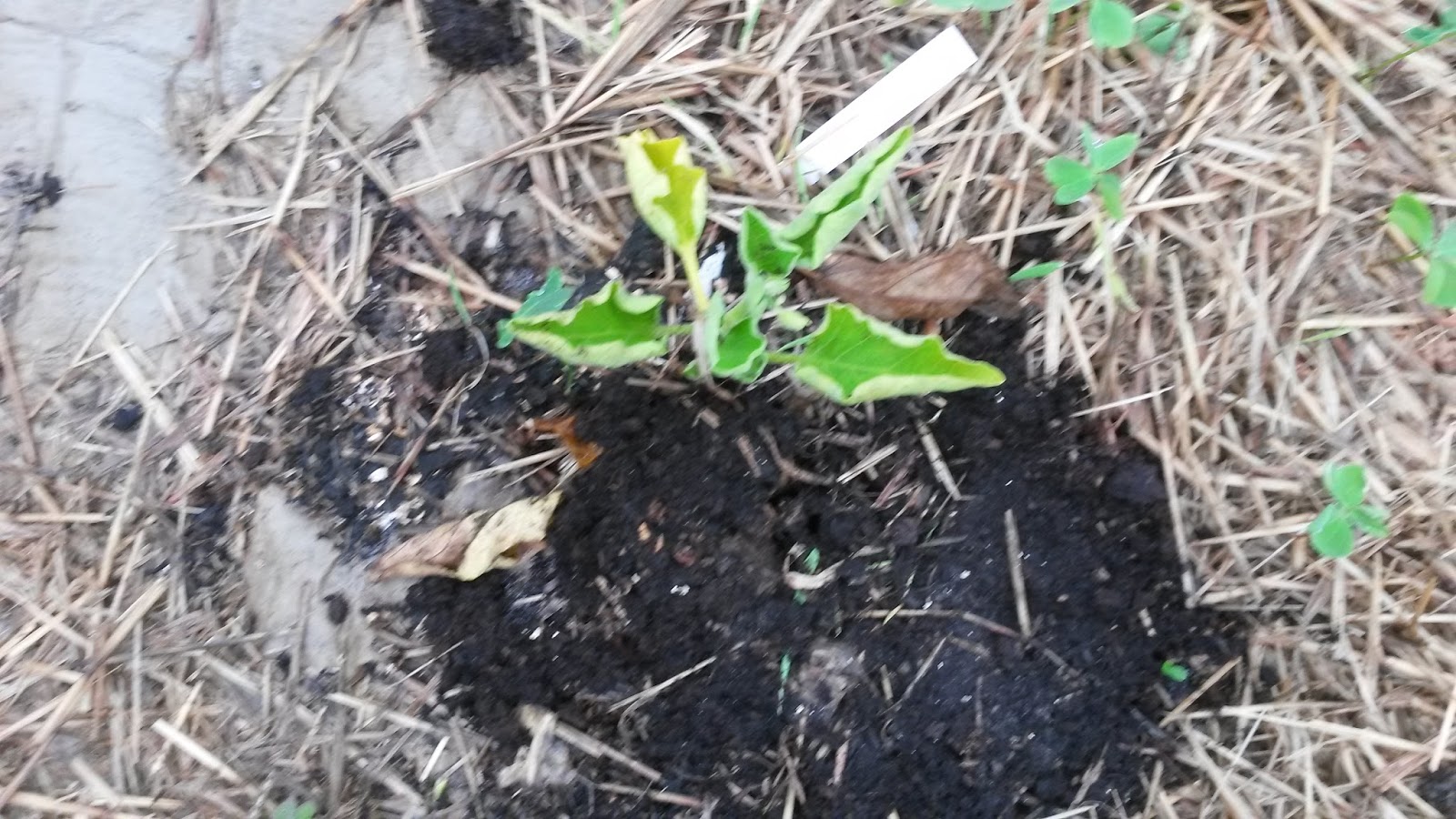
I have improved that situation somewhat (same plant seven weeks later)


Baratzea naturally falls into four plots. The lower two (2&3) are doing quite well, the upper two (1 &4) require more attention.

Plot 1: Pumpkins and maize 


Plot 2: a little bit of everything that was available in May: though mostly onions, peppers, cabbages and fennel 


Plot 3: tomatoes and potatoes 


Plot 4: mostly beans and cabbage family (still to be planted) 


Plots 1 and 4 seem to be suffering from a fertility/compaction  problem.  The soil on these higher plots seems to have more clay, less loam and opens up less easily .  I’m working on that and will continue to do so over the coming season.  

The main challenge is building ‘an edge zone’ along the fences.  I’ve planted sunflowers, lupins, raspberries and other ‘barrier’ plants, but so far so few of them have taken.  Slowly I am working on that challenge too.  Check out my progress in a few weeks' time. 

Saturday, 15 July 2017

Serendipity in the Bibliotheque


One of the books that I found at the Planete Ecole stall yesterday was just what I was looking for: an illustrated history of the Tour de France.  It was true serendipity since a) the tour was in the Pyrenees that very day and b). I was just rewriting a section of my book about the Pyrenees that involved me doing some fact checking about the very first tours to pass through the Pyrenees.  They were fascinating times: the guy charged with reconnoitring  the route spent a night lost on  the Col de Tournalet (the highest paved pass on the French side of the mountains) in freezing conditions having walked across the pass as the car he hired couldn't cross because of the depth of the snow.  He sent a telegram back to L'Auto in Paris saying 'the route is fine.'   Three years later a certain Eugene Christophe who was running just behind the leader, had his bike almost totalled when it was run over by a car.  At that time there were no spare bikes and riders were not allowed to call on outside mechanical help so he carried his bike 14km down the mountain to the nearest village and welded the frame back together himself in the local forge, while officials watched on to make sure the smithy didn't help him.   He wasn't able to gain back the time he lost, but he earnt himself a place in the 'people's history book' . 

But this photo made me smile: Maurice Garin, winner of the first tour de France in 1902. Check that ciggie hanging out of the corner of his mouth! 


Monday, 26 June 2017

memories of Glastonbury

With all the media exposure of Glastonbury this weekend I realised that I was last there in 1997: thirty years ago.  (Sir!) Van Morrison was highlighting and I was very pleased to find bootleg cassettes of his performance for sale about an hour after he finished: impressed by the efficiency of the production system  that could knock out,  I don't know how many, copies of his performance in a field at such short notice.  I still have the cassette, sadly not the means to play it :-(.

Monday morning leaving site I shredded the two back tyres on my beloved Bedford CA ambulance and had to nurse it into the nearest town to get two new ones fitted before driving back to London.
Image result for Bedford CA Ambulance 1965

Why was that my last Glastonbury?  It was partly the feeling that it had grown too big, too commercial, but more so, a few weeks later, I moved 'up north': t'Alifax. After ten years as a southerner when I planned my summer activities around the festival circuit I now had access to the Pennines, the Peaks and the Lakes and, on longer weekends, the Highlands.   A new world of OB opened to me and the idea of spending my summer weekends on crowded camp sites queueing for overpriced beer and dirty toilets just its allure.  Or perhaps I was just moving on.  It's not that I never go to festivals any more, but the last I went to less than a thousand people, stunning views and no queues at the bar.  I knew all my camping neighbours by name by the time I left!


Saturday, 27 May 2017

Doing the stats on migration

This table is hugely interesting - if you can appreciate, and are fascinated by, statistics. It shows the number and percentage of EU and non EU-citizens living in each member state (+EFTA/Schengen members).  

Looking at this table produced some surprises for me.  One would think from all the current rhetoric that the UK is being overrun by migrants. Yet if you look at column 2 non-native UK residents make up less than 10% of the UK's population. There are 11 countries where this figure is more than 10%, so the UK is an averagely-favoured migration location not the 'honey pot' that some claim. 

If you then look at EU migration figures the proportion of non-native EU residents in the UK is just below 5%, putting in (about) no. 10 in the most favoured locations for EU (and EFTA/Schengen citizens) to relocate to. (I'm doing these calculations in % rather than than real terms). 

Then if you look at column 6 Thirteen EU/EFTA countries have a higher percentage of residents of non EU origin - which is actually quite suprising given Britain's colonial history.

All this makes me wonder: why are the Brits so up in arms about this? It's not a 'being swamped by Johnny-foreigner' things (as I thought might the case). It's something about the British mentality. 


Monday, 15 May 2017

Baratzea: Week 16

Baratzea: Week 16

The next week I made frequent visits to new plot, just to look at it, measure it, see what is there, and work out way is North (it didn’t correspond a tall with my intuitive feel).   There wasn’t much left but was left was of value.  A strawberry bed, a couple of artichoke plants already as tall as me, a couple of rose and hydrangea bushes, a decent amount of compost and most importantly 5x 200 litre water barrels  rain fed from the roof of the garage and interconnected by a series of pipes.   I met the neighbour who gardens the plot above mine (the garden is split into two plots) who mostly grows flowers, together with a few potatoes and strawberries.  One afternoon I met Jean Pierre bringing over a bundle of freshly cut bamboo stakes as a gift for her to use to train her tomatoes and peppers.    Bamboo grows in abundance around here and is a really useful resource for gardeners and other D-i-Y’ers.  The modesty/wind screen on my balcony is largely made out of bamboo stakes and woven matting.    The stakes that Jean Pierre brings are freshly cut, sturdy and green and look fantastic.  

It’s good to meet Jean Pierre.  He tells me a little about the quality of the garden, the variations in soil quality, that he never runs out of rain water, that he has taken three water barrels but left me five and some compost and the strawberries. I get the impression he is angling for something but feel that that debt, imaginary or real, can be repaid later in the year with some harvest.  He says he minimised his use of pesticides, although some more radical bio neighbours disagreed with that.  I am not going into commercial production so I don’t have to worry about conversion periods or past applications too much. 

And while I am thinking about what resources are on the land I am also thinking about what resources I have got and those I ned to find:  there are some seeds that I sowed in March with the intention of planting them on my balcony and on the tiny plat that I have negotiated on my jardin collectif’s terrain across the border by the airport in Hondarribia. But that plot is much smaller and my first year’s seeding programme was set back by torrential rainfall, which drowned many of the pots and my cat scratching out a large number that remained.  Strong winds blew away many of the labels, so although I can see the difference between the surviving tomatoes, pumpkins and beets – I don’t actually know which varieties are which anymore.   It’s going to be speed date, rather than companion planting this year.

The plan is to do a permaculture garden – minimising the digging and building a productive and aesthetically pleasing garden – the later important as it is in such a visible public space.   At the moment the plot is surrounded by bare chain link fencing so it looks quite unloved.  I want to prioritise planting barrier species along the perimeters to slow down wind speeds, reflect heat, reduce any pollution from cars and make the plot look and feel self-contained.   My first tasks are to locate cardboard, from supermarket skips and to recuperate the two bales of hay left over from preparing my plot in Spain.  The latter proves to be hard work as the hay has been out in the rain for three months.  Normally I can lift a bale of hay easily by myself, but being so wet I can only to lift about a sixth a bale at any one time.  It takes a long time to load it, and unload it.  My car which I had swept out a few days ago before its technical control, once again starts to resemble, and smell like, farm machinery.   


My 'Partner': a perfect fit for four bales of hay. 

By the end of the week I have two of the six plots and a third of the perimeter fencing covered with cardboard and bakers’ sacks (there is new organic bakery immediately opposite the land who is willing to supply me with a limitless supply) and mulched over.  I have planted in a few things that I hope will be fast growing and give me and passers- by the illusion of quick progress:  three rhubarb cutting and a sprig of mint (in an otherwise not very useful step on the wall between the gardens where it can spread as much as it likes),  a buddleia  (to attract butterflies) two fig trees, a laurel and an iris that were volunteers on the plot of land around my co-working space at Cocoba and a dozen or so pumpkin and courgette seedlings that were getting too big for their pots.  Hopefully they will all quickly grow and spread and make the garden look less like a desert.      


My system for laying down 'a lasagne garden': first the cardboard - easy to work and place when it comes in one metre square sheets (though it's better to tack the sellotape off before laying it down) with a 'slice' from a hale bay placed on each which i then spread out.  Later the weeds from my neighbours garden will go on top. One bale covers about five square metres , which takes about an hour and half to prepare. 

Sunday, 14 May 2017

Baratzea: week 0


There’s a little patch of land in the centre of my quarter, le bas quartier, a triangle enclosed by three roads that is a beautiful and charming garden.  During the winter I noticed that half of it was completely neglected. It looked like nobody had paid it any attention for a long time.  I asked around the neighbourhood to try to find out who owns it and it if I might not be able to use it.   Two people said that they know the owner who lives in Bordeaux but comes back every so often as he has a house here and the former gardener who wanted to give up the plot for health reasons.  Weeks passed by and nothing happened.  


The week before Easter the previous user of   the garden cut back everything on the plot back ready for cultivating this season and then 'handed in his notice'.  Two days later Elizabeth who works in the épicerie that faces directly onto the plot gave me the number of Michel, the owner ,and suggested I call him.  I thought about how to ‘present’ myself before calling him the next day.  He was delighted to find someone interested in taking over the plot as he was planning to post a notice in the local shops to try to find somebody to take over the garden when he next came back to Hendaye. Even better Michel didn’t want rent – just someone who would keep the patch tidy and keep his good standing in the community.  Then he threw in the bonus, telling me that that I could have access to his garage, attached to the plot to keep my tools in – although he wants to retain access to it to park his car whenever he comes back to Hendaye.  He suggested that we meet next time he came down to Hendaye, probably in three to four weeks’ time.  I said that’s fine but it will be really late in the growing season by then.  Michel said he’ll see what he can do. As I put the phone down I felt a sense of joy that the angels had dropped this present into my lap and pride that I had been able to negotiate a ‘contract’ on a piece of land so easily in French. 

But better was yet to come. Two or three hours later I was passing Panxika’s house and she called me over.  ‘I spoke to Michel and he asked about you’.  Apparently my reputation had been preceded me: she had already spoken to Michel (an old, old, friend of hers) about the Englishman who had joined and was supporting the residents’ association.   Michel put two and two together and asked Panxika if we were one and the same person.  She said yes.  ‘So he’s going to let you have the garden.  But don’t tell him I told you so’.   Later that evening Michel called me saying that he heard about me from the neighbours, that he thought I was responsible and that I could pick up the keys to the garage from Panxika  tomorrow, so I could get on with the garden and we could meet when he came back to Hendaye in a few weeks’ time.    Game on!


Easter Saturday I went round to Panxika’s to pick up the keys to the garage.  We went to check out the garage.  Ample space for my tools and Michel’s car, with enough left over for me to store a bike (my last one got stolen when I left it chained to the same lamp-post for three months over the winter and ) and back up supply of wood for the winter months (I live on the third floor of a residence with no lift, so buying wood in bulk is problematic – whenever I explain the situation the price for a cubic metre of wood  doubles from around 50-60 Euro to more than 100 – not surprisingly given the extra work involved in hauling it all up three flights of stairs).  The only downer is that Jean Pierre, who worked the garden before me, has already sold all his tools. But I have the double benefit of a garden 100m away from my home and free storage space.  Having the tools on tap would be like the winning the roll-over ball on the lottery.   Opening and closing the garage doors is in itself a tactile experience – they are old style, concertina-design, wooden doors, the kind I associate with 1930s black and white movies.  I imagine these garages could have been built when people wealthy enough to run a car also had a uniformed chauffeur:  ‘We’ll need the Roller tonight, James’ .  It certainly feels like a new door has opened.