Showing posts with label Hendaye. Show all posts

Thursday, 2 November 2017

Go up to the mountains 1

There is a mountain (the three crowns) that I can see from my flat – most days – when there’s not too much cloud. To my shame I have been looking at it for more than a year but not yet climbed it.


A couple of weeks ago I rectified that: with the aid of a half-way  decent Spanish walking map I worked out where to start from and how best to tackle it. And, with two brave British couch-surfers we made our bid. 

As the name suggests the three crowns has three peaks: we made the first two: the gap between the second and third proved beyond our mountain skills without a rope.   Although less than 1000m high it is  a serious mountain.  There was some serious scrambling involved!

 It was a lovely day out though, with the best views yet across Bidasoa and back to Hendaye. 

Tuesday, 5 September 2017

View from Port Plaisance

Took my new bicycle for a test spin yesterday evening just before sunset.  I chanced upon what has to be one of the most beautiful panoramas of Bidasoa, taken from Port Plaisance.  It captures the three mountains that define and frame this watershed.  One can nearly always see one of them no matter where you are, but I'd never seen all three together in the same frame.


From top to bottom:
La Rhune (the highest of the three) with a full moon rising to the left (sadly not visible in the photo)
Les Trois Corrounes, the wildest and most forested, with a mantle of cloud
Jaizkibel, the most westerly peak of the Pyrenees, with Hondarribia catching the evening sun.  There was a drumming festival on the  Spanish side so the whole valley was reverberating with drum sounds, like Carnaval was taking place.   


Sunday, 13 August 2017

Randonne

A short couple of hours stroll from the chapel at Guadalupe to Jaizkibel (543m) the last peak before the Pyrenees tumbles into the Atlantic.  The Bay of Figs and the Bay of Biscay on my right hand side,  La Rhune and the Three Crowns on the right:  Ohri, the western-most 2000m peak visible for just a few minutes before arriving at the look-out point at Jaizkibel.  A short but very enjoyable walk.


The view from Guadalupe across the Bidasoa towards La Rhune, 
possibly the best 'Mirador' on the Bidasoa.


The Three Crowns from Jaizkibel

Thursday, 27 July 2017

Baratzea – July

Yesterday I was working in the garden when a woman came passing by (as people are wont to do in such a public space).

‘Is that Comfrey (Solidage)? Where did you get it?’


I was impressed. Most people ask me what it is.

‘The guy who sold me my apartment left a potful on the terrace. I’ve been propagating it ever since. It takes really easily ’

‘Do you know where can I get some?’

‘If you wait a moment I will dig you up a root’.

I dug up a young shoot, put in a pot and gave it to her.  My visitor, who I have never met before, was delighted.  So was I.  Comfrey was, symbolically, the first thing I planted on the plot, to build fertility.  Over the past few months I have been given so many plants, seeds, gardening equipment (tools, stakes etc.) and composting materials so it was a real pleasure to start to return those favours. 

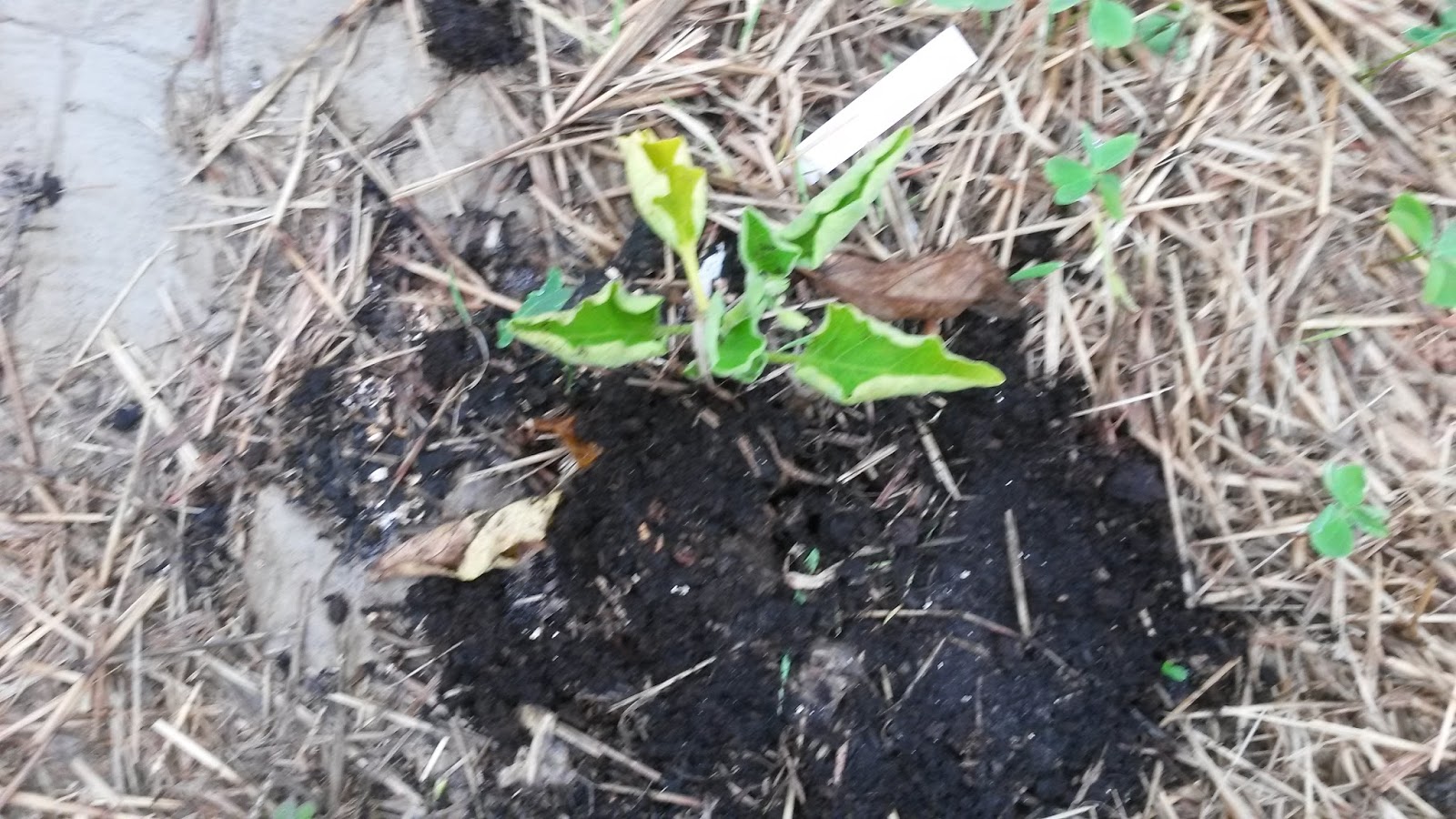
Baratzea looked like an ecological disaster zone two months ago.  Nitrogen demanding bacteria were busy consuming the cardboard and straw I had put down to suppress weeds, leaving no N for the plants, no matter what I threw at them.


I have improved that situation somewhat (same plant seven weeks later)


Baratzea naturally falls into four plots. The lower two (2&3) are doing quite well, the upper two (1 &4) require more attention.

Plot 1: Pumpkins and maize 


Plot 2: a little bit of everything that was available in May: though mostly onions, peppers, cabbages and fennel 


Plot 3: tomatoes and potatoes 


Plot 4: mostly beans and cabbage family (still to be planted) 


Plots 1 and 4 seem to be suffering from a fertility/compaction  problem.  The soil on these higher plots seems to have more clay, less loam and opens up less easily .  I’m working on that and will continue to do so over the coming season.  

The main challenge is building ‘an edge zone’ along the fences.  I’ve planted sunflowers, lupins, raspberries and other ‘barrier’ plants, but so far so few of them have taken.  Slowly I am working on that challenge too.  Check out my progress in a few weeks' time. 

Wednesday, 29 March 2017

market day

Wednesday is market day in Hendaye. As the weather becomes more clement and the days longer the market is starting to flesh out with the stalls that I last saw here last summer. A large portion of the traders here are producers and I now know which ones to go to for cheese, pate, sheeps' and cows' milk, yoghurt and Breuille, the skimmed whey from cheese making. The first locally grown strawberries (from a tunnel) are on sale.

Several of the traders already know my preferences and suggest supplements or alternatives. One of them a farm just inland won a silver medal for its ham at the Paris Agricultural/food show in February. Another remarked that I was wearing a linen jacket: ' Today, yes but I haven't put my winter coats in the cupboard yet' was my reply.

Yesterday I lost a cheque made out to me and was going frantic with worry. This morning the owner of the local Presse called me to tell me I had dropped something in her shop and call by and collect it any time. I did (with huge relief) and then stopped by my bank to open a business account. I am now 75% of the way to becoming a registered 'auto-entrepreneur' - a micro-business. I've spent three weeks putting together dossiers (fichiers in French) and am very pleased to see them go through with only small hiccups.

In the meantime my seeds are sprouting (apart from the spinach which has keeled over in the heat this afternoon). My wallflowers, which stayed in flower all winter, are now up to neck height: I've never seen wallflowers grow so tall.  My geranium, inherited from the last owner of my flat, which I put under severe stress last year, has started to flower. Honeysuckle and sweet peas are finding the strings designed to encourage their growth up towards the guttering and the tiles.  Oh and a neighbour has a bag full of locally caught mackerel for me to collect this evening.


The tragic reality of Brexit lingers but I am learning to focus on the positive things in life. The gullibility of the UK electorate (expressed in May 2105 as well as June 2016) and the intransigence of both sides of the House of Commons (well there's only one side now - the only real opposition is the SNP) would otherwise have destroyed me. It almost did. It's been a long struggle since I am so emotionally, politically, psychologically and financially connected with the EU. Somehow I have this idea (perhaps naive) that whatever shit hits the disunited kingdom financially and diplomatically will trash the Tory party and the 'two party' state beyond repair. 

Saturday, 4 March 2017

Extreme weather

Yesterday, after two successful, official, meetings in SaintJean de Luz I found myself drawn to the beach in Hendaye.  It was warm and the recent high tides had washed up lots of driftwood.  I found myself beachcombing pieds nus in just a tee shirt (the first time this year).  Three hours or so later, having carried four boxes of wood up three flights of stairs I found myself on the other side of the border collecting panniers for our box scheme.  The wind had picked up so much that it blew my hat off twice and was blowing sand into my eyes.  When I got home most of the labels in my seed pots had been blown away.   So much for companion planting:  this year it will be speed-date  planting.   

That evening I forgot to bring my seed trays inside.  It pissed down.  Easily an inch and half of rain.  My seed trays (mostly fashioned out of discarded water bottles) were completely swimming in water. Not good.  ‘Duh I forgot something’.  I spent most of this morning punching holes into those bottles with a safety pin to let the water drain out.  Five hours later they look a bit healthier.  Sigh of relief. 

This afternoon I went to a meeting in Biarritz, thirty kilometres up the coastline.  It was sunny when I left.  It was pissing down with gale force gusts of wind when we arrived.    On the way back the ambient temperature increased from 6 to 12 degrees between Biarritz and St Jean de Luz - a distance of maybe 20km   I was out on the balcony in a t shirt half an hour ago.  Now it’s hailing.  I immediately bought the seed trays back in and in less than a minute my shirt was wet through. 


Today is Carnaval in Hendaye (it’s put back a week here: either so as to not compete with the events on the Spanish side of the border – or to allow the locals more opportunities to party).  I can already hear the marching bands bravely playing in the storm.  In an hour or so an effigy of San Patzar (the symbol of winter) will be put ‘on trial’ in the town square and then burnt (his guilt is not in question). I hope it’s not premature.  

Thursday, 2 March 2017

Bio-bakery

Hendaye has a new organic bakery, that is actually the closest shop to my house.  It's a fair distance from the town centre (down a steep hill) but seems to be doing a roaring trade one week after opening. There's always a queue running outside the door. Perhaps we are seeing the first signs of gentrification.  So go Marco go!

Thursday, 23 February 2017

Radio Hendaye

My tuner only picks up Spanish radio stations.  (Yes sometimes I like to turn on my radio rather than manage internet based radio). Imagine my surprise this evening when I turned on radio three and heard a Scouse accent coming out of the speakers.  'Have I been beamed up?' I thought.  Within a few seconds I recognized the voice. It was Ringo. You know the Beatles not-very-good drummer: promoting his new album with Paul, the only surviving other member of what was undoubtedly the world's most successful and influential pop group That made me profoundly aware of what I lose as an immigrant /ex-pat.  However long I live in France, however hard I try to assimilate its culture, I will never be able to turn on the radio and know by the sound of a voice - oh that's Ringo, that's Will Self, that's Jo Brand or whoever.

Tuesday, 3 January 2017

Hendaye now and then


Le Sud-Ouest recently carried an article with a series of aerial photographs of the French Basque Coast produced by L'institut nationale d'information geographique et foresterie comparing what places looked like in the 1950s and today.  This pair of photos of Hendaye and the Bidasoa estuary show just how many changes have occurred in my lifetime (though of course I was not here to see them then).

The airport and the marina didn't exist, the freight yards at the railway terminus have been greatly expanded (again into the estuary), housing sprawl on the French side has greatly expanded, and the fields (water meadows?) in the flood plain around Irun have been converted into recreational and amenity land and the estuary by and large tamed.  That's quite a lot of changes!


Wednesday, 28 December 2016

A year in the Basque Country

Following an inactive month on the blog front here's my best photos of the year.  Enjoy.


The Bridges of Hendaye  

 Bidasoa Estuary

 Fluffy white clouds

 Springtime in Bassussarry

Basque Money

Saying goodbye to Ribaucourt

 
 Steps in Hendaye town

 The Hokey-Cokey: Hendaye Carnival


 Yes we do drinking: Hendaye Carnival 

 The freight yards at Hendaye

Poplar trunk 

 The day the Burlesque came to town

 
                                                                 Autumn harvest


Friday, 25 November 2016

On 'getting wood' (part 2)

It's been seventeen years since I last lived somewhere with a log buring stove. I missed the rituals a great deal and now I'm  a  happy bunny. In the words of Henry Thoreaux:  wood heats you three times: once when felling it, once while splitting it and once when burning it.  He didn't mention carrying it up three flights of stairs (though fair play its still three times for me as I don't 'fell' wood. I hunt out fallen, beached, wood and dry (broken) palettes from the back of local stores).


My life is starting to evolve around wood.  Making a bulk purchase isn't an option for reasons I explained in a previous blog on the same subject.  So I am forced into becoming a professional scavenger / recycler.  Yesterday I  fillled up the van in an hour, at least a week's worth.    When I got home I realised I didn't want to do twelve trips up the stairs (even as training for keeping up with the relentless uphill pace of Roberto on our occasional hikes).  So I called my tennis partner, whom I had helped move house the previous week,  to ask for a 'coup de main' after our coaching session.   He obliged and I duly replenished my wood shed.  A few hours later I went to pick up a veg box from a Xavier's house around the corner.   He was busy unloading MASSIVE logs from the boot of his small car and pleased for the helping hand in unloading it.  We made a appointment for Tuesday: me, him, my van, his chainsaw.  (Do you think I should tell him beforehand that I live on the third floor wth no lift ?) 

Monday, 14 November 2016

On 'getting wood'


We’ve just had ten days of seemingly incessant rain on the Basque Coast.  My scientific ‘how much water is there in the bucket?’ methodology suggested we had 50% more than the median rainfallfor all of November (the wettest month of all in this wet location) in the first five days of that period.  After that the buckets were full and I stopped counting.  Three days before the rains began I had my beach mat, sunscreen and sandals packed for the beach.   Yesterday, tidying up the flat I decided to put them into storage for the winter.  

After five days I ran out of wood.  I had been sporadically collecting bits of driftwood and abandoned wooden furniture over the summer, my cleaner’s son turned up with a 10 Euro load a few days before the rains hit in, but it was all soon burnt.  That which was left needed sawing into stove size logs and the rain never let up.  I kept a close eye on the skies. Whenever it stopped raining I would head down to a couple of points on the bay where the driftwood gathers and there are nearby parking places, or cruise the industrial estate looking for abandoned palettes.  

I could, and should, have ordered a cubic metre of logs weeks ago.  But it wasn’t so simple.   The going rate around here is 50 Euro for a cubic metre.  But when I let slip that I live on the third floor without a lift the price suddenly doubles.   No one, myself included, wants to haul a cubic metre of wood up three flights of stairs.  So my wood acquisition habits are going to have to be slow and stealthy and ensure a steady supply rather than buying in my winter’s supply in one fell swoop. 

Over the past ten days I have got very good at learning how to mix quite humid driftwood, with well-seasoned older wood (about 2 parts to 1 does the trick).  Last night I even learned the trick of keeping the fire in all night. I was thrilled when I lifted the log, blew under it sparked back into flame.   But today it was unnecessary. The sun has come back and my balcony doors are open again with a fire smouldering at the minimum level to keep it in for the evening .

'Getting wood' is one thing, getting rid of it is quite another 

Systems have inputs and outputs.  Acquiring the inputs to keep my fire going has been difficult but I didn’t give enough thought as to what to do with the outputs.   I merrily thought I could just feed the planters on my balcony with the ashes.  After all that is how agriculture worked for millennia until land pressure got too much  and people had to move beyond slash and burn.  I might have rather overdone it.  Some planters got rather too much too ash, which when it rained again, turned into a impermeable clay like layer on the top of the soil.  I did some internet searching about optimum application rates. The University of Illinois’sextension service had some rather useful advice.  

When water comes in contact with wood ashes, it forms potassium hydroxide. This compound is highly alkaline and can rapidly raise soil ph. For this reason, wood ash should be viewed as a liming material and used carefully. Wood ashes should not be applied to high pH soils (> 6.5).  

And

Never use more than 20 pounds per 1000 square feet because toxicity problems could result from excessive usage.

I think I might have exceeded the recommended dosage: done the Gardener’s World equivalent of a ‘Keith Richards’.  Today I went around all the planters I had fertilised and removed as much of the ashes I could and put them in a bin to go to the local communal garden’s compost.  I don’t know if my ferns,  retrieved from landfill in Cornwall, still very weak after being transplanted from Brussels are going to survive the experience.  They are acid loving after all.

Still my garden hasn’t given up on summer yet! 


Saturday, 29 October 2016

Trying to live within our planet's means.

Since moving into my new flat, five months ago,  I have tried to avoid buying ANYTHING new (except treating myself to a couple of new T-shirts and summer shorts).  I have largely succeeded.  My bed, couch, tables, and bike were all bought off le Bon Coin, at  vide-greniers or at Emmaus (I used to be a frequent visitor to the one in Wageningen and was pleased to find one just across the border in Irun - though it took me several  visits to find as it is located on an out-of-the-way trading estate).  Rugs (one of them still in its wrapper), curtains and side tables were all picked up by my cleaner from people with more money than sense: trashing their 'unfashionable' furniture.
   

 The two nicest things I have found are a lampshade and a table lamp.  With darker evenings coming in some soft lighting is much appreciated.  The pair cost me 5 euro from   the Red Cross in Jonceaux (Hendaye's industrial zone).  I particularly like the 'sun lampshade', which must be hand made and sat absolutely perfectly to an existing light fitting in the hall - even the screw holes matched the fitting!


The one new household item I have bought is a kettle. I will probably succumb to a bookcase from IKEA (holds up crucifix), a blender and saw.   It's not just (or even mainly) about saving money. It's more that there is enough 'stuff' on this planet already.    I’d rather spend my money in the service economy than deplete the planet’s resources.

I am also trying to avoid anything made of plastic.  I was given a link to a nearby company that sells worms and composters. I was kind of interested, but then realised that buying a plastic worm composter was a contradiction (unless the plastic was recycled, but I didn't see that highlighted on their website).  In the end I opted to make one out of polystyrene fish trays,  that would otherwise go to landfill.  A member of my Jardin Collectif has given me some Tiger Worms from his chicken run - I put them all together this week and am just waiting for the worms to settle in and do thier business. It has been an ongoing project for two months.  I'm sure glad it's finished

My local organic shop sells its grains, pulses nuts and seeds loose so there is no packaging apart from a paper bag which can be used to light a fire.  I'm pleased with that.  What is bugging me  is that every time I need to buy light bulbs, printer cartridges, screws, washers or plugs they come wrapped in tough and out-sized plastic packages.  I wish I could find a traditional quincaillerie that sold things like that loose and in paper bags.