Showing posts with label Baratzea. Show all posts

Tuesday, 28 November 2017

Baratzea - November

I've just had a crash course in wild and semi-wild plants. I met a traveller this summer admiring my garden and we immediately hit it off and went on several foraging missions together. She's been back in Hendaye for a few days and every day we have been exploring my garden ad the open spaces of Hendaye with her teaching my the names and uses of the wild plants in my environment.  And then going home and spreading out five botanicae on the floor checking out the names and uses that my friend doesn't know.

These days there's not so much work to be done in the garden so it's been great to move forward with my (somewhat dormant) project of getting to know the names and uses of the plants around me.


Top to bottom then left to right
Banana leaf (ideal for a lampshade)
Sunflower head (30cm diameter)
Chard
unknown berries
Palm and wisteria seeds
Mache (Lamb's lettuce)
Primula


Rocket


Lamb's lettuce


Cresson de Fontanine

Monday, 14 August 2017

Baratzea week 31

Last week it mostly rained every day, so I took advantage of the bad weather to catch up on my food processing (especially since I bought a freezer the week before) .

Two panniers of vegetables from my garden and the jardin collectif to process.  


Stuffed peppers, fried peppers


One kilo of string beans 


Melon with ham and Mozzarella and Gazpacho


(and not photographed aubergine pate and potato and corgette chowder).   All in all about eight hours' work, but suddenly my grocery bill is down to dairy products, an occasional piece of meat or fish and cat food.    .

Thursday, 27 July 2017

Baratzea – July

Yesterday I was working in the garden when a woman came passing by (as people are wont to do in such a public space).

‘Is that Comfrey (Solidage)? Where did you get it?’


I was impressed. Most people ask me what it is.

‘The guy who sold me my apartment left a potful on the terrace. I’ve been propagating it ever since. It takes really easily ’

‘Do you know where can I get some?’

‘If you wait a moment I will dig you up a root’.

I dug up a young shoot, put in a pot and gave it to her.  My visitor, who I have never met before, was delighted.  So was I.  Comfrey was, symbolically, the first thing I planted on the plot, to build fertility.  Over the past few months I have been given so many plants, seeds, gardening equipment (tools, stakes etc.) and composting materials so it was a real pleasure to start to return those favours. 

Baratzea looked like an ecological disaster zone two months ago.  Nitrogen demanding bacteria were busy consuming the cardboard and straw I had put down to suppress weeds, leaving no N for the plants, no matter what I threw at them.


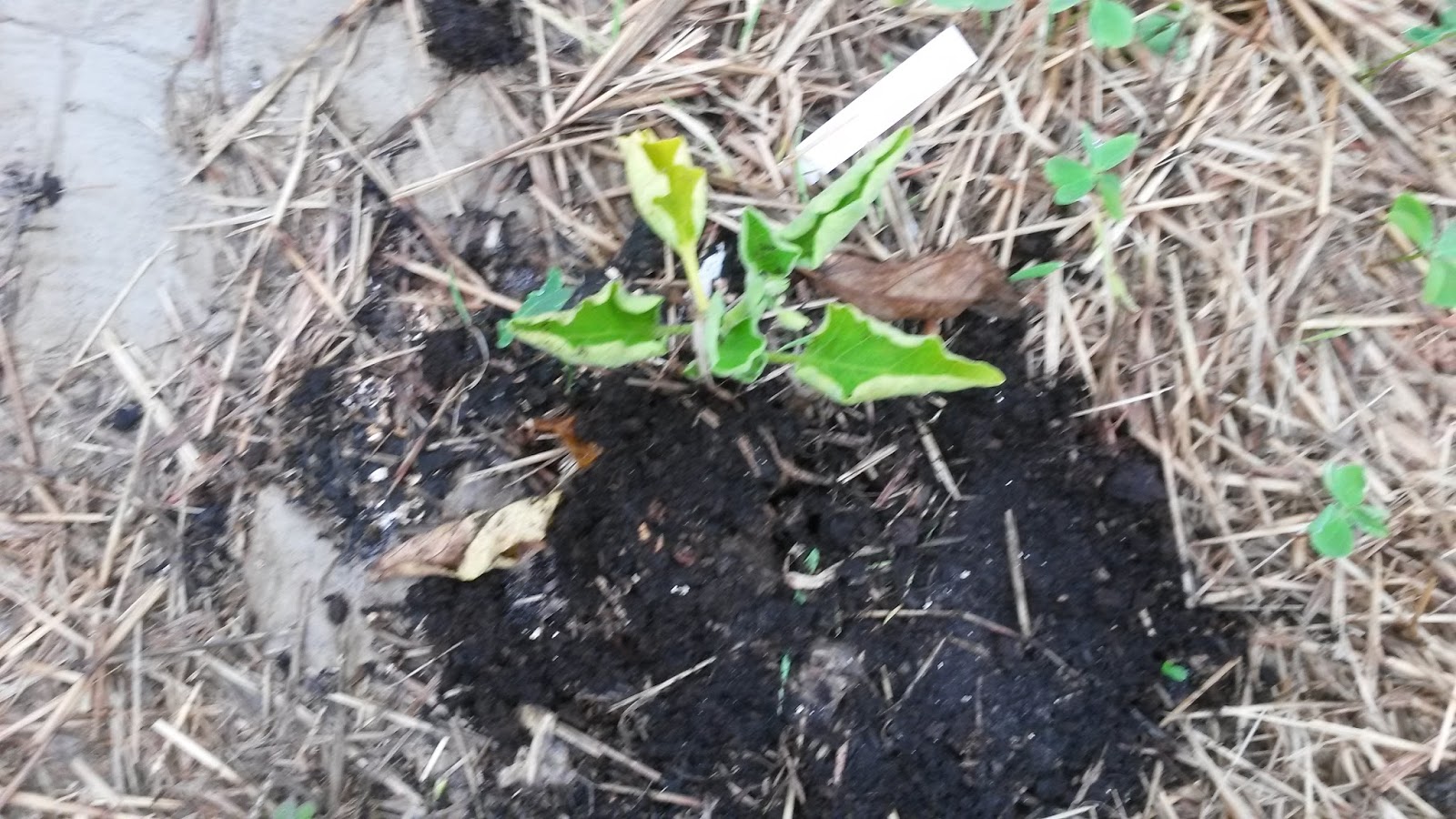
I have improved that situation somewhat (same plant seven weeks later)


Baratzea naturally falls into four plots. The lower two (2&3) are doing quite well, the upper two (1 &4) require more attention.

Plot 1: Pumpkins and maize 


Plot 2: a little bit of everything that was available in May: though mostly onions, peppers, cabbages and fennel 


Plot 3: tomatoes and potatoes 


Plot 4: mostly beans and cabbage family (still to be planted) 


Plots 1 and 4 seem to be suffering from a fertility/compaction  problem.  The soil on these higher plots seems to have more clay, less loam and opens up less easily .  I’m working on that and will continue to do so over the coming season.  

The main challenge is building ‘an edge zone’ along the fences.  I’ve planted sunflowers, lupins, raspberries and other ‘barrier’ plants, but so far so few of them have taken.  Slowly I am working on that challenge too.  Check out my progress in a few weeks' time. 

Monday, 15 May 2017

Baratzea: Week 16

Baratzea: Week 16

The next week I made frequent visits to new plot, just to look at it, measure it, see what is there, and work out way is North (it didn’t correspond a tall with my intuitive feel).   There wasn’t much left but was left was of value.  A strawberry bed, a couple of artichoke plants already as tall as me, a couple of rose and hydrangea bushes, a decent amount of compost and most importantly 5x 200 litre water barrels  rain fed from the roof of the garage and interconnected by a series of pipes.   I met the neighbour who gardens the plot above mine (the garden is split into two plots) who mostly grows flowers, together with a few potatoes and strawberries.  One afternoon I met Jean Pierre bringing over a bundle of freshly cut bamboo stakes as a gift for her to use to train her tomatoes and peppers.    Bamboo grows in abundance around here and is a really useful resource for gardeners and other D-i-Y’ers.  The modesty/wind screen on my balcony is largely made out of bamboo stakes and woven matting.    The stakes that Jean Pierre brings are freshly cut, sturdy and green and look fantastic.  

It’s good to meet Jean Pierre.  He tells me a little about the quality of the garden, the variations in soil quality, that he never runs out of rain water, that he has taken three water barrels but left me five and some compost and the strawberries. I get the impression he is angling for something but feel that that debt, imaginary or real, can be repaid later in the year with some harvest.  He says he minimised his use of pesticides, although some more radical bio neighbours disagreed with that.  I am not going into commercial production so I don’t have to worry about conversion periods or past applications too much. 

And while I am thinking about what resources are on the land I am also thinking about what resources I have got and those I ned to find:  there are some seeds that I sowed in March with the intention of planting them on my balcony and on the tiny plat that I have negotiated on my jardin collectif’s terrain across the border by the airport in Hondarribia. But that plot is much smaller and my first year’s seeding programme was set back by torrential rainfall, which drowned many of the pots and my cat scratching out a large number that remained.  Strong winds blew away many of the labels, so although I can see the difference between the surviving tomatoes, pumpkins and beets – I don’t actually know which varieties are which anymore.   It’s going to be speed date, rather than companion planting this year.

The plan is to do a permaculture garden – minimising the digging and building a productive and aesthetically pleasing garden – the later important as it is in such a visible public space.   At the moment the plot is surrounded by bare chain link fencing so it looks quite unloved.  I want to prioritise planting barrier species along the perimeters to slow down wind speeds, reflect heat, reduce any pollution from cars and make the plot look and feel self-contained.   My first tasks are to locate cardboard, from supermarket skips and to recuperate the two bales of hay left over from preparing my plot in Spain.  The latter proves to be hard work as the hay has been out in the rain for three months.  Normally I can lift a bale of hay easily by myself, but being so wet I can only to lift about a sixth a bale at any one time.  It takes a long time to load it, and unload it.  My car which I had swept out a few days ago before its technical control, once again starts to resemble, and smell like, farm machinery.   


My 'Partner': a perfect fit for four bales of hay. 

By the end of the week I have two of the six plots and a third of the perimeter fencing covered with cardboard and bakers’ sacks (there is new organic bakery immediately opposite the land who is willing to supply me with a limitless supply) and mulched over.  I have planted in a few things that I hope will be fast growing and give me and passers- by the illusion of quick progress:  three rhubarb cutting and a sprig of mint (in an otherwise not very useful step on the wall between the gardens where it can spread as much as it likes),  a buddleia  (to attract butterflies) two fig trees, a laurel and an iris that were volunteers on the plot of land around my co-working space at Cocoba and a dozen or so pumpkin and courgette seedlings that were getting too big for their pots.  Hopefully they will all quickly grow and spread and make the garden look less like a desert.      


My system for laying down 'a lasagne garden': first the cardboard - easy to work and place when it comes in one metre square sheets (though it's better to tack the sellotape off before laying it down) with a 'slice' from a hale bay placed on each which i then spread out.  Later the weeds from my neighbours garden will go on top. One bale covers about five square metres , which takes about an hour and half to prepare.